
What is a ha ha? If you’ve ever heard someone say the phrase, you might think it’s a joke. But it’s actually a curiously real landscape feature that dates back to the 18th century.
Yes, it has a very odd name. But the feature itself had a key role in preserving some of the landscapes that we still enjoy today.
Ha-ha’s were part illusion and part practical. They gave estate owners uninterrupted views across the landscape, while keeping grazing animals a safe distance from their homes and formal gardens.
History and Origins
The concept of a “ha ha” originated in France. They were first described in print by Dezallier d’Argenville in La Theorie et la Practique du Jardinage (1709). He noted that the hidden ditch and wall surprised visitors, prompting an exclamation of “ah-ah!” that gave the feature its unusual name.
Two of the earliest known examples in England are at Levens Hall in Cumbria, created in the 1690’s by Guillaume Beaumont, and Stowe Gardens in Buckinghamshire. Within a few decades, they were installed at estates across the country.
Their popularity reflected the changing tastes of the Georgian era, when naturalistic landscapes became fashionable for elite landholders. One even made its way into the design of the Royal Crescent in Bath, England. It’s still in place today and separates the private Royal Crescent garden from Victoria Park.
Design and purpose of a ha ha wall
It’s deceptively simple: a deep sunken ditch, with the garden side (called a lawn in America) supported by a stone or brick wall that’s built from the bottom of the ditch up to ground level. The opposite side slopes gently upward, away from the wall, blending with the surrounding turf.
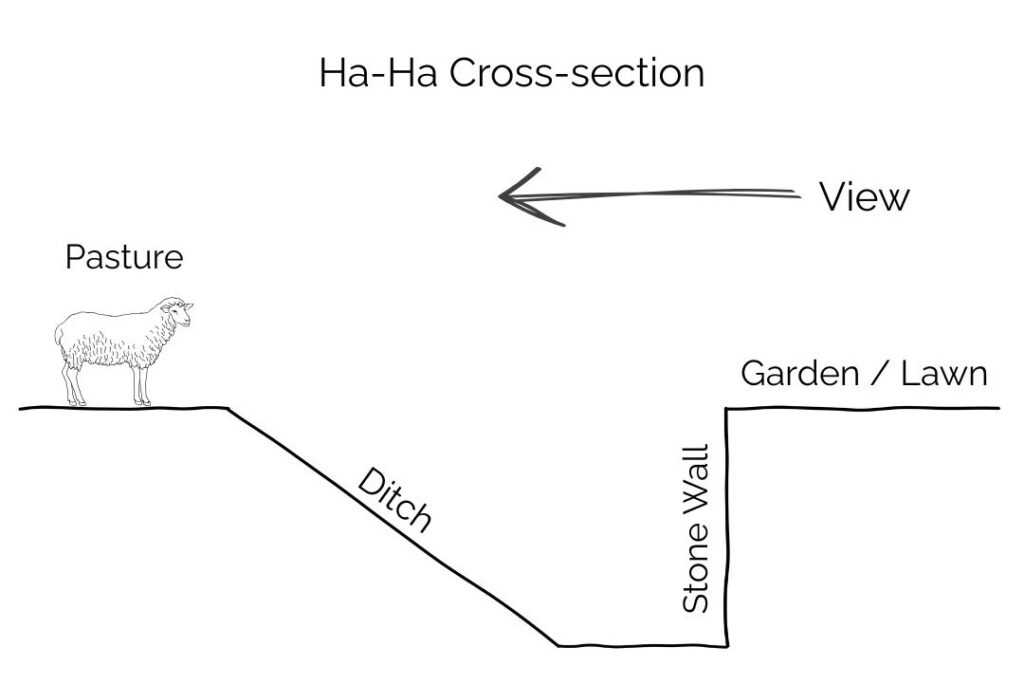
They’ve been described as a “hidden wall in the landscape”. From the garden side, the view is unbroken. From the opposite side, the barrier is tall enough to keep grazing animals like sheep or cattle out of the manicured grounds.
The home and formal gardens are on the garden side, with the livestock beyond. Grazing livestock can walk down the sloped side of the ditch, below ground level, up to the wall. They aren’t able to jump the vertical wall to get to the other side, due to the depth of the ditch.
The concept built on an older tradition that began with the medieval deer park. “Deer-leaps” were used in broad areas that let the deer in, but prevented them from escaping. They controlled movement without enclosing the entire landscape. The ha-ha built on this idea, but for a new era that was highly focused on beauty and order without feeling forced.
Ha-Ha’s in Culture & Literature
They quickly became more than a simple way to keep grazing sheep away from the formal gardens. Writers and designers praised them as essential tools of a new landscape style. They were a core element in many gardens designed by Capability Brown. Alexander Pope encouraged his friend Richard Boyle to “conceal the bounds” of his gardens with them. Poet Joseph Addison linked the uninterrupted views to peace of mind and virtue.
By the late 18th century, they were so familiar that Jane Austen could reference one in Mansfield Park without explanation. Visitors to Stowe also recorded their impressions, including Thomas Jefferson. In 1786 he wrote that “the inclosure is entirely by Ha! Ha!”
Geography & Spread
Ha-ha’s are most strongly associated with English gardens, but have also spread across the British Isles and beyond. In Scotland, one was built in the 19th century at the north end of the private Regent, Royal and Carlton Terrace Gardens.
The idea also crossed the Atlantic. George Washington had them installed at Mount Vernon, where he referred to them both as a “ha haw” and “deer wall”. They preserved the view of the Potomac River while controlling livestock.
In the early 2000’s, a modern ha-ha was constructed around the Washington Monument in Washington D.C. to provide security without disrupting sightlines. Canada has a few surviving examples as well, including one at Uniacke Estate in Nova Scotia.
Where to See Ha Ha’s in England
It’s still possible to find excellent examples across Britain:
- Stowe, Buckinghamshire – one of the earliest examples
- Petworth, Sussex – Designed by Capability Brown
- Croome, Worcestershire – Designed by Capability Brown with more than two miles integrated into the design
- Berrington Hall, Herefordshire – Capability Brown’s final commission, featuring one as a long boundary
- Levens Hall, Cumbria – one of the earliest known examples in England
Additional examples can be found in England at Benningborough Hall (Yorkshire), Kedleston Hall (Derbyshire), Kingston Lacy (Dorset), and Hidcote Manor Garden (Gloucestershire). In Scotland, another example can be found at Hopetoun House (South Queensferry) near Edinburgh.
Frequently Asked Questions
Where did the name come from?
The name comes from the surprise visitors felt when they suddenly noticed the hidden ditch. In French, “ah-ah!” was an exclamation of surprise, which became “haha” in English.
What’s the purpose?
It creates the illusion of an unbroken garden (or lawn, in America) while serving as a boundary. It kept livestock out of formal gardens without a fence spoiling the view.
Where can I see one today?
You can find them across the UK but especially in England at estates like Stowe, Petwork, Croome, and Berrington Hall and Scotland at Hopetoun House. They exist in North America at Mount Vernon in the United States and Uniacke Estate in Canada.
Take a Closer Look
The next time you wander through the gardens of a grand estate, take a closer look at the landscape. That smooth stretch of lawn may be hiding a boundary while giving you great views. It’s a small detail with a big story. And it’s proof that even something as simple as a deep ditch can be used in creative and ingenious ways.
Looking for more inspiration? Read on for more posts about Castles and Gardens, or dive into our England or Scotland blog posts.
What is a ha ha? If you’ve ever heard someone say the phrase, you might think it’s a joke. But it’s actually a curiously real landscape feature that dates back to the 18th century.
Yes, it has a very odd name. But the feature itself had a key role in preserving some of the landscapes that we still enjoy today.
Ha-ha’s were part illusion and part practical. They gave estate owners uninterrupted views across the landscape, while keeping grazing animals a safe distance from their homes and formal gardens.
History and Origins
The concept of a “ha ha” originated in France. They were first described in print by Dezallier d’Argenville in La Theorie et la Practique du Jardinage (1709). He noted that the hidden ditch and wall surprised visitors, prompting an exclamation of “ah-ah!” that gave the feature its unusual name.
Two of the earliest known examples in England are at Levens Hall in Cumbria, created in the 1690’s by Guillaume Beaumont, and Stowe Gardens in Buckinghamshire. Within a few decades, they were installed at estates across the country.
Their popularity reflected the changing tastes of the Georgian era, when naturalistic landscapes became fashionable for elite landholders. One even made its way into the design of the Royal Crescent in Bath, England. It’s still in place today and separates the private Royal Crescent garden from Victoria Park.
Design and purpose of a ha ha wall
It’s deceptively simple: a deep sunken ditch, with the garden side (called a lawn in America) supported by a stone or brick wall that’s built from the bottom of the ditch up to ground level. The opposite side slopes gently upward, away from the wall, blending with the surrounding turf.
They’ve been described as a “hidden wall in the landscape”. From the garden side, the view is unbroken. From the opposite side, the barrier is tall enough to keep grazing animals like sheep or cattle out of the manicured grounds.
The home and formal gardens are on the garden side, with the livestock beyond. Grazing livestock can walk down the sloped side of the ditch, below ground level, up to the wall. They aren’t able to jump the vertical wall to get to the other side, due to the depth of the ditch.
The concept built on an older tradition that began with the medieval deer park. “Deer-leaps” were used in broad areas that let the deer in, but prevented them from escaping. They controlled movement without enclosing the entire landscape. The ha-ha built on this idea, but for a new era that was highly focused on beauty and order without feeling forced.
Ha-Ha’s in Culture & Literature
They quickly became more than a simple way to keep grazing sheep away from the formal gardens. Writers and designers praised them as essential tools of a new landscape style. They were a core element in many gardens designed by Capability Brown. Alexander Pope encouraged his friend Richard Boyle to “conceal the bounds” of his gardens with them. Poet Joseph Addison linked the uninterrupted views to peace of mind and virtue.
By the late 18th century, they were so familiar that Jane Austen could reference one in Mansfield Park without explanation. Visitors to Stowe also recorded their impressions, including Thomas Jefferson. In 1786 he wrote that “the inclosure is entirely by Ha! Ha!”
Geography & Spread
Ha-ha’s are most strongly associated with English gardens, but have also spread across the British Isles and beyond. In Scotland, one was built in the 19th century at the north end of the private Regent, Royal and Carlton Terrace Gardens.
The idea also crossed the Atlantic. George Washington had them installed at Mount Vernon, where he referred to them both as a “ha haw” and “deer wall”. They preserved the view of the Potomac River while controlling livestock.
In the early 2000’s, a modern ha-ha was constructed around the Washington Monument in Washington D.C. to provide security without disrupting sightlines. Canada has a few surviving examples as well, including one at Uniacke Estate in Nova Scotia.
Where to See Ha Ha’s in England
It’s still possible to find excellent examples across Britain:
- Stowe, Buckinghamshire – one of the earliest examples
- Petworth, Sussex – Designed by Capability Brown
- Croome, Worcestershire – Designed by Capability Brown with more than two miles integrated into the design
- Berrington Hall, Herefordshire – Capability Brown’s final commission, featuring one as a long boundary
- Levens Hall, Cumbria – one of the earliest known examples in England
Additional examples can be found in England at Benningborough Hall (Yorkshire), Kedleston Hall (Derbyshire), Kingston Lacy (Dorset), and Hidcote Manor Garden (Gloucestershire). In Scotland, another example can be found at Hopetoun House (South Queensferry) near Edinburgh.
Frequently Asked Questions
Where did the name come from?
The name comes from the surprise visitors felt when they suddenly noticed the hidden ditch. In French, “ah-ah!” was an exclamation of surprise, which became “haha” in English.
What’s the purpose?
It creates the illusion of an unbroken garden (or lawn, in America) while serving as a boundary. It kept livestock out of formal gardens without a fence spoiling the view.
Where can I see one today?
You can find them across the UK but especially in England at estates like Stowe, Petwork, Croome, and Berrington Hall and Scotland at Hopetoun House. They exist in North America at Mount Vernon in the United States and Uniacke Estate in Canada.
Take a Closer Look
The next time you wander through the gardens of a grand estate, take a closer look at the landscape. That smooth stretch of lawn may be hiding a boundary while giving you great views. It’s a small detail with a big story. And it’s proof that even something as simple as a deep ditch can be used in creative and ingenious ways.
Looking for more inspiration? Read on for more posts about Castles and Gardens, or dive into our England or Scotland blog posts.

